

The impact of artificial sweeteners on our health: a review of the evidence
Met de opkomst van caloriearme voeding en dieetdranken zijn kunstmatige zoetstoffen voor vele niet meer weg te denken. Maar wat zijn de mogelijke gevolgen van het gebruik van deze zoetstoffen? Op dit moment worden kunstmatige zoetstoffen gereguleerd door de overheid, en alleen die zoetstoffen waarvan is aangetoond dat ze veilig zijn voor consumptie, mogen worden verkocht. Desalniettemin zijn er steeds meer aanwijzingen dat kunstmatige zoetstoffen een negatief effect kunnen hebben op onze gezondheid. Alleen al in 2022 en 2023 zijn er talloze RED FLAG onderzoeken op het gebruik van zoetstoffen.
In this article, we will discuss what science has discovered so far about artificial sweeteners and their effects on human health.
What are artificial sweeteners?
Artificial sweeteners are sweeteners that contain little to no calories, but have a higher sweetening power per gram than sweeteners with calories, such as table sugar, honey or corn syrup. They are also referred to as low-calorie sweeteners, not-nutritieve zoetstoffen, suikervervangers en zoetstoffen met hoge intensiteit. Deze zoetstoffen zijn veelvoorkomende ingrediënten in een breed scala aan voedingsmiddelen en dranken, waaronder zuivelproducten, diepvriesdesserts, gebak, snoep, kauwgom, ontbijtgranen en ingeblikt voedsel. Veel producten die worden verkocht als “suikervrij” of “dieet” bevatten één of meer suikervervangers. Sommige kunstmatige zoetstoffen worden ook afzonderlijk verkocht als algemeen gebruikt zoetmiddel.
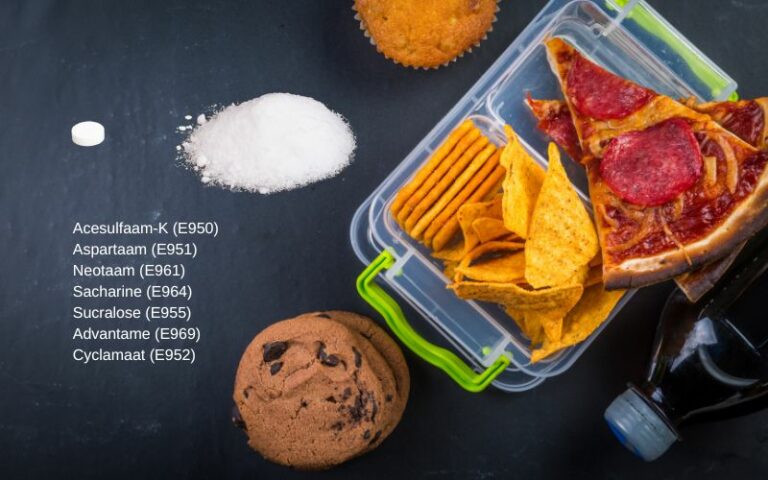
Below we give you an overview of the most common artificial sweeteners in foods:
- Acesulfaam-K (E950) – 200 times sweeter than sugar
- Aspartaam (E951)- 200 keer zoeter dan suiker
- Neotaam (E961)- 7.000-13,000 times sweeter than sugar
- Sacharine (E964) – 200-700 times sweeter than sugar
- Sucralose (E955)- 600 keer zoeter dan suiker
- Advantame (E969)- 20.000 keer zoeter dan suiker
- Cyclamaat (E952)- 30 tot 50 keer zoeter dan suiker
Sorbitol and xylitol are not included in this article because they also occur in nature and are therefore not considered artificial sweeteners. Synthetic sugar substitutes, such as acesulfame-K, aspartaam en sucralose, zijn door de mens gemaakt en worden daarom op een andere manier opgenomen en gemetaboliseerd dan veel andere voedingsstoffen.
What are the dangers of sweeteners
In addition to the specific health aspects, there are also other considerations when using artificial sweeteners. For example, some people experience side effects such as headaches, digestive problems or allergic reactions when consuming these sweeteners. It is important to assess on an individual level how a person responds to the use of artificial sweeteners and seek advice from a health professional if necessary.
Although artificial sweeteners are often used as an alternative to sugar, some concerns have been raised about their potential health effects. For example, several studies have suggested that artificial sweeteners could play a role in diabetes weight gain, metabolic disorders, cancer and an increased risk of type 2 diabetes.
Sommige onderzoeken hebben gesuggereerd dat kunstmatige zoetstoffen de eetlust en hunkering naar zoetigheid kunnen vergroten, wat kan leiden tot een hogere calorie-intake. This can be especially problematic if people think they are saving calories by switching to artificial sweeteners and then eat more to make up the calorie difference.
Bovendien kan het gebruik van kunstmatige zoetstoffen invloed hebben op onze darmgezondheid. Er is opkomend onderzoek dat suggereert dat ze de samenstelling van darmbacteriën kunnen beïnvloeden, wat een rol kan spelen bij de stofwisseling en de algehele gezondheid. Meer onderzoek is nodig om deze effecten volledig te begrijpen en de langetermijneffecten op de menselijke gezondheid te beoordelen.
Artificial sweeteners are not automatically healthier than natural sugars. Although they are lower in calories, they can still contribute to a craving for sweets and can be found in highly processed foods that contain other unhealthy ingredients.
Recent studies on artificial sweeteners
The latest research does not bode well for the sweetener industry. Recent studies shed a disturbing light on artificial sweeteners and their potential impact on health. These findings are raising concerns for the sweetener industry, as more and more studies suggest their use poses risks. The once-lauded alternatives to sugar are now facing critical findings pointing to possible negative effects on several aspects of health. These developments are an important point of attention and stimulate further research into the safety and long-term effects of artificial sweeteners and perhaps even a ban on them.
Sweetener Aspartame and acesulfame-K verhoogt kans op kanker
This large cohort study that took place between 2009 and 2021 included a total of 102,865 adults from the French NutriNet population cohort-Santé (2009-2021). Het onderzoek bracht kunstmatige zoetstoffen, met name aspartaam en acesulfaam-K, die veelvuldig worden gebruikt in voedingsmiddelen en dranken wereldwijd, in verband met een verhoogd risico op kanker.
What were the researchers' findings?
In this large study, the results of which were published in 2022, artificial sweeteners (mainly aspartame and acesulfame-K) geassocieerd met een verhoogd algeheel kankerrisico (hazard ratio [HR] voor hogere consumenten vergeleken met niet-gebruikers = 1,13 [95% CI 1,03 tot 1,25], P-trend = 0,002).
Aspartame intake was associated with increased breast cancer risk (HR = 1.22 [95% CI 1.01 to 1.48], P = 0.036) and obesity-related cancer risk (HR = 1.15 [95% CI 1.01 to 1.32], P = 0.026).
Source: PubMed
Sweetener sucralose increases the risk of cancer and DNA damage
A byproduct of sucralose, a chemical in the popular calorie-free sweetener Splenda, has been shown to cause damage to DNA, increase the risk of cancer and cause leaks in the intestinal lining, according to a new May 29, 2023 study from North Carolina State University. Splenda is used as a sugar substitute in thousands of foods, drinks, desserts and candies.
Sweetener saccharin increases blood sugar levels and changes to the gut microbiome
Another 2022 study published in the journal CellTrusted Source found that sucralose – and saccharin – could potentially increase blood sugar levels. This is linked to a higher risk of type 2 diabetes, heart disease and stroke.
In this study, these sugar substitutes not only caused a rise in blood sugar levels like normal sugar, but they also caused changes in the microbiome. This means that these sweeteners do not pass through the body without any effect, as previously believed by researchers. The gut microbiome is a collection of bacteria and other microbes that live in the intestines. Disruptions in the microbiome can contribute to obesity, type 2 diabetes, inflammatory bowel disease (IBD) and certain types of cancer.
Source: CellTrusted Source
Sweetener erythritol increases the risk of blood clots
Onderzoekers hebben een groep van meer dan 4.000 personen uit de Verenigde Staten en Europa bestudeerd en geconstateerd dat degenen met hogere concentraties erythritol in hun bloed een verhoogd risico hadden op ernstige cardiovasculaire gebeurtenissen, zoals hartaanvallen, beroertes en overlijden. Daarnaast hebben ze ook de effecten onderzocht van het toevoegen of erythritol to both whole blood and isolated platelets, which are cell components that clump together to stop bleeding and contribute to blood clots. The results showed that erythritol activated platelets more easily and promoted clot formation. Preclinical studies confirmed that consuming erythritol increased clot formation.
Onderzoekers verklaarde: “Onze bevindingen laten zien dat deelnemers die een kunstmatig gezoete drank consumeerden met een erythritolgehalte dat veel voorkomt in verwerkte voedingsmiddelen, gedurende meerdere dagen aanzienlijk verhoogde niveaus in hun bloed hadden – niveaus die ver boven de drempel liggen waarop het risico op stolling toeneemt. Het is van groot belang dat er verdere veiligheidsstudies worden uitgevoerd om de langetermijneffecten van kunstmatige zoetstoffen in het algemeen, en erythritol in het bijzonder, op het risico van hartaanvallen en beroertes te onderzoeken, vooral bij personen met een verhoogd risico op hart- en vaatziekten.”
Source: Cleveland Clinic