

Why reading labels is important?
Labels are informational labels placed on food packaging. They contain important information about the product, such as the ingredients, nutritional value, allergens and expiration date. Reading and understanding labels is essential for conscious consumers as it allows them to make informed choices when choosing foods. Reading labels contributes to a healthy and informed food choice. In this article we explain how you can learn to read labels.
You will find the following on food labels:
- List of ingredients
- Best before date or best before date and storage advice
- Quality marks
- Claims
- Nutri Score
- Reference intake
- Product description
- Nutritional value table
- Net quantity
- Allergens
- For example, where the product comes from contains: brown Basmati rice from Pakistan and India has less arsenic than brown rice from other Asian countries
You've probably noticed some of these aspects before, while others may be new to you. I will further elaborate on the parts that you can find on labels that are important in understanding this
Read ingredients list
Reading the ingredients list is an important part of reading labels. It gives you insight into what is actually in a product. When reading the ingredients list, you will always see the ingredients with the highest quantity at the top. This means that the first ingredient is present the most and the last ingredient is the least.
A shorter ingredient list often indicates a healthier product, but you should also pay attention to unwanted additives such as artificial colors and flavors, preservatives and added sugars. For people with special dietary needs, such as gluten or lactose intolerance, it is especially important to read the ingredients list carefully to identify allergens.
Essential tips for reading the ingredients list
- Start by reading the ingredients list. This is where you get a detailed overview of the ingredients present in the product.
- Pay attention to the order of the ingredients. The ingredients are listed in order of quantity, so the first ingredient is the most present.
- Avoid products whose ingredient list is full of unknown or difficult to pronounce ingredients. Prefer to choose products with recognizable and natural ingredients.
- Be alert to the presence of unwanted additives such as artificial colors and flavors, preservatives and added sugars.
- Check whether any allergens are present in the product.
Common ingredients you don't want in a product
When reading the ingredients list, it is important to pay attention to common ingredients that are less healthy. Some examples of this are added sugars, such as glucose-fructose syrup or maltodextrin, artificial sweeteners such as aspartame or sucralose.
To make their products appear more tempting, manufacturers often turn to alternative ingredients than normal sugar. It may therefore seem as if there is no sugar in it, but in practice that is often the case. You should also pay attention to trans fats such as hydrogenated oils, artificial colors and flavors and preservatives such as sodium benzoate. Avoiding these ingredients can contribute to a healthier food choice.
List of ingredients and table of nutritional values
When evaluating a nutrition label, in addition to paying attention to the list of ingredients, you should also consult the nutritional values table. This gives you information about the quantities of nutrients present and their value
The table with nutritional information contains the following data: the amount of kilocalories, proteins, fats, saturated fats, carbohydrates, sugars and salt present in a product per 100 grams or 100 milliliters (and also per portion). Fiber is not always listed, but is still part of the nutritional information.
Bringing these elements together can help you determine whether the product is a healthy option or a less healthy one.
Best before date and best before date
What is the difference between a best before date and a use by date?
The date 'Best before' (THT) This is mainly found on products that have a longer shelf life. The quality of the item may deteriorate after this date, but it does not mean that the food has gone bad immediately. It is generally still safe to consume the product after the best before date.
De “Te Gebruiken Tot” date appears predominantly on quickly perishable goods that require refrigeration. After this date there is a risk of illness. You will find this indication on goods such as meat, fish and cut vegetables. It is unwise to eat foods after the expiry date.
Claims
A nutrition claim makes a positive statement about the contents of a specific product. Such a claim is a verified statement about a characteristic of a product, for example that it is rich in fiber, free of sugar, low in salt content or without salt. You have already seen some of these claims above.
Food products cannot simply carry a health claim; they must meet certain conditions. Just because a product has a certain claim does not mean that it is healthy. Take, for example, a cookie enriched with extra calcium; this may still contain a high number of calories, sugar or saturated fats. So don't be fooled by claims such as: , pure natural, source of fiber, low in fat or light. Always check the list of ingredients and the nutritional table.
Deciphering marketing claims on packaging
It is important to be able to decipher marketing claims on packaging so that you as a consumer are not misled. Some claims may sound very tempting, but they are not always truthful. Here are some tips for deciphering marketing claims on packaging:
- Read the claims critically: Be skeptical and ask yourself whether the claim is realistic. If something seems too good to be true, it often is.
- Look for specific information: A good marketing claim should be supported by specific information, such as studies or percentages. If this is missing, it may be a false claim.
- Check the ingredients list: Sometimes a product may have a healthy claim, but the ingredients list may still contain unhealthy or questionable ingredients. Don't be fooled by the claim alone.
- Vergelijk met andere merken: Vergelijk de claims van verschillende merken om te zien of er grote verschillen zijn. Als een merk claimt de gezondste optie te zijn, maar andere merken hebben vergelijkbare claims, dan is het belangrijk om wat dieper te graven.
- Consult reliable sources: If you have doubts about a marketing claim, look for information from reliable sources such as nutritionists, scientific studies or recognized quality marks.
Deciphering marketing claims is important to ensure that you, as a conscious consumer, make the right choices when purchasing food. Be critical, do your research and don't be misled by fancy words on the packaging.
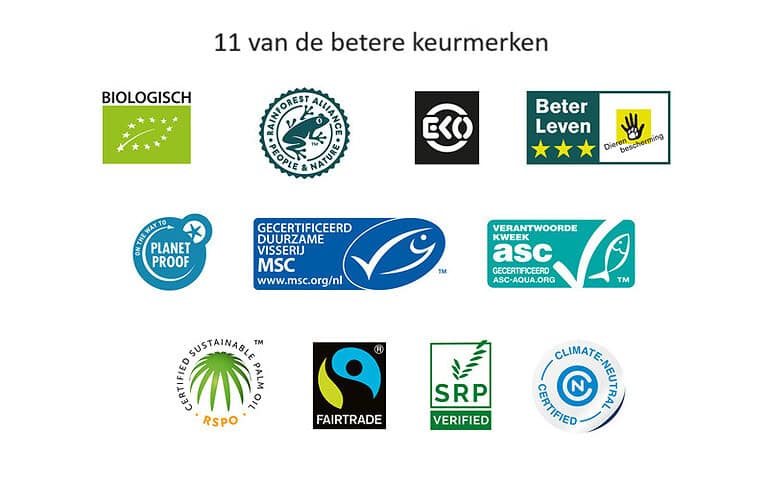
Quality marks
Quality marks on nutrition labels can help consumers make conscious choices. Quality marks such as the organic quality mark, the Fairtrade quality mark and the MSC quality mark indicate that the product meets certain sustainability or quality standards. However, be aware that some claims on packaging may be purely marketing ploys. It is important to understand the meaning and validity of quality marks before using them as a guide to your purchases.
Meaning and validity of quality marks on labels
Quality marks on food labels indicate that the product meets certain sustainability or quality standards. It is important to understand the meaning and validity of these labels before using them as a guide to your purchases. Some quality marks are awarded by independent organizations with strict criteria, while other quality marks may be less reliable. It is advisable to inform yourself about the reliability, independence and control of the organization behind the quality mark before relying on the claims on the label.
Allergen identification
Identifying allergens on labels is very important for people with food allergies or intolerances. By clearly labeling allergens, consumers can safely select foods that are appropriate for their diet. It also helps prevent severe allergic reactions and provides peace of mind to consumers. It is essential to read the ingredients list carefully and look for possible allergens before purchasing a product.
Importance of identifying allergens on labels
Identifying allergens on labels is very important for people with food allergies or intolerances. By clearly labeling allergens, consumers can safely select foods that are appropriate for their diet. It also helps prevent severe allergic reactions and provides peace of mind to consumers. It is essential to read the ingredients list carefully and look for possible allergens before purchasing a product.
Common allergens and their names
When reading labels, it is important to be aware of the most common allergens and their names. The following allergens are commonly found in food products and must be carefully identified on labels:
- Gluten: May be present in wheat, rye, barley or oats.
- Milk: May be listed as milk, lactose, casein, or whey.
- Eggs: Usually listed as eggs or albumen.
- Fish: May be listed as fish or shellfish.
- Nuts: may be listed as almonds, hazelnuts, walnuts, cashews or pistachios.
- Soy: May be listed as soy or soy lecithin.
- Crustaceans: may be listed as shrimp, crabs, lobsters or mussels.
- Peanuts: Usually listed as peanuts or peanut oil.
- Sesame Seed: May be listed as sesame seed or sesame oil.
- Sulfites: May be listed as sulfites, sulfite dioxide, or sulfur dioxide.
It is important to recognize and avoid these allergens if you have a food allergy or intolerance. Make sure you read the ingredient list carefully and understand the possible names of these allergens.
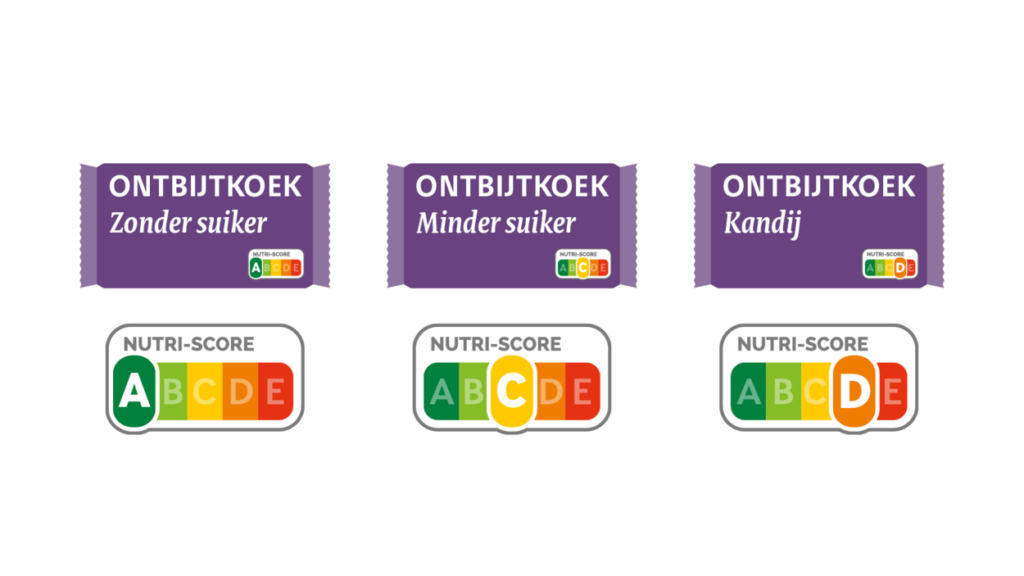
What is the Nutri-Score classification on the label?
The Nutri-Score classification is based on a color scale with five categories, ranging from green (A) to red (E). Products with a green color are considered healthier, while products with a red color are less healthy. In addition to the color, each category is also represented by a letter, to make it easier to understand the classification. The aim is to give consumers quick and easy insight into the nutritional value of a product.
How is the Nutri-Score calculated and applied?
The Nutri-Score is calculated using a points system. Products get plus points for good nutrients, such as fiber, proteins, vegetables, fruit, nuts and legumes. On the other hand, they receive negative points for less good nutrients, such as a high amount of energy, saturated fat, sugar and salt. Manufacturers can influence the Nutri-Score by, for example, adding extra fiber to a product. The Nutri-Score is displayed on the product packaging and helps consumers make conscious nutritional choices.
Criticism of the Nutri-Score as an indicator of health
The Nutri-Score also faces criticism when it comes to acting as an indicator of health. Some critics argue that the system places too much emphasis on calorie content and does not adequately take into account other important nutrients, such as vitamins, minerals and antioxidants. Furthermore, the Nutri-Score can be misleading, as certain products with a healthy score may still have other negative aspects, such as processed ingredients or added sugars. It is important to use the Nutri-Score in combination with other factors when assessing the healthiness of a product.
- Nutrients such as vitamins, minerals and antioxidants are not fully included in the Nutri-Score.
- Products with a healthy score may still have other negative aspects, such as processed ingredients and added sugars.
- It is important to combine the Nutri-Score with other criteria when assessing the healthiness of a product.
Summary for conscious consumers when reading labels
- Always read the ingredients list. The order of the ingredients indicates how much of each ingredient is in the product. The higher an ingredient is on the list, the more of it is present in the product. Try to choose products with a shorter ingredient list, as this often means they contain fewer added and processed ingredients.
- Pay attention to the nutritional value table. This table contains important information about the nutritional value of the product, such as the amount of calories, fat, sugar, fiber and protein. Compare the nutritional values of different products to make the healthiest choice.
- Identify allergens. Be sure to check any allergens on the label, especially if you are allergic to certain ingredients such as peanuts, gluten or milk. Manufacturers are required to clearly state allergens on the label.
- Understand expiration dates and storage requirements. Check the expiration date to ensure the product is still safe to consume. Also pay attention to the storage instructions, such as keeping products that are sensitive to spoilage cool.
- Wees kritisch ten opzichte van keurmerken en marketingclaims. Niet alle keurmerken op etiketten zijn betrouwbaar, dus doe wat onderzoek om te begrijpen wat een specifiek keurmerk betekent. Let ook op vage marketingclaims zoals “gezond”, “natuurlijk” of “light”, omdat deze termen niet altijd goed gedefinieerd zijn.
- Stay informed and consult reliable sources. Labels and nutritional guidelines may change, so make sure you stay up to date with the latest information and guidelines. Consult reliable sources such as nutritionists, health organizations and government websites for up-to-date advice.
Reading labels is important because it helps consumers make more conscious choices about what they put into their bodies. By reading the ingredients list and nutritional value table, consumers gain insight into the composition and nutritional value of the product. This allows them to compare products and choose the healthiest option.
If you are allergic to certain ingredients, it is important to check the ingredients list carefully. Manufacturers are required to clearly state allergens on the label. If you have an allergy, avoid products that contain the allergen. If you are unsure, consult a nutritionist to determine whether the product is safe to consume.
Not all quality marks on labels are reliable, so it's important to do some research. Consult reliable sources such as nutritionists, health organizations and government websites to find information about specific labels. They can help you understand what a particular quality mark means and whether it is reliable.
It is important to check the expiration date on the label before consuming a product. If the “use by” date has passed, it is safer not to consume the product as it may affect its quality or safety. Discard the product to avoid the risk of food poisoning. Products with an expiration date 'Best Before' (THT) can still be used.
The information on labels and nutritional guidelines may change, so it is important to stay informed. Consult reliable sources such as nutritionists, health organizations and government websites for the latest information and guidelines. Stay informed and ensure you have up-to-date knowledge to make healthy and conscious choices when purchasing food.